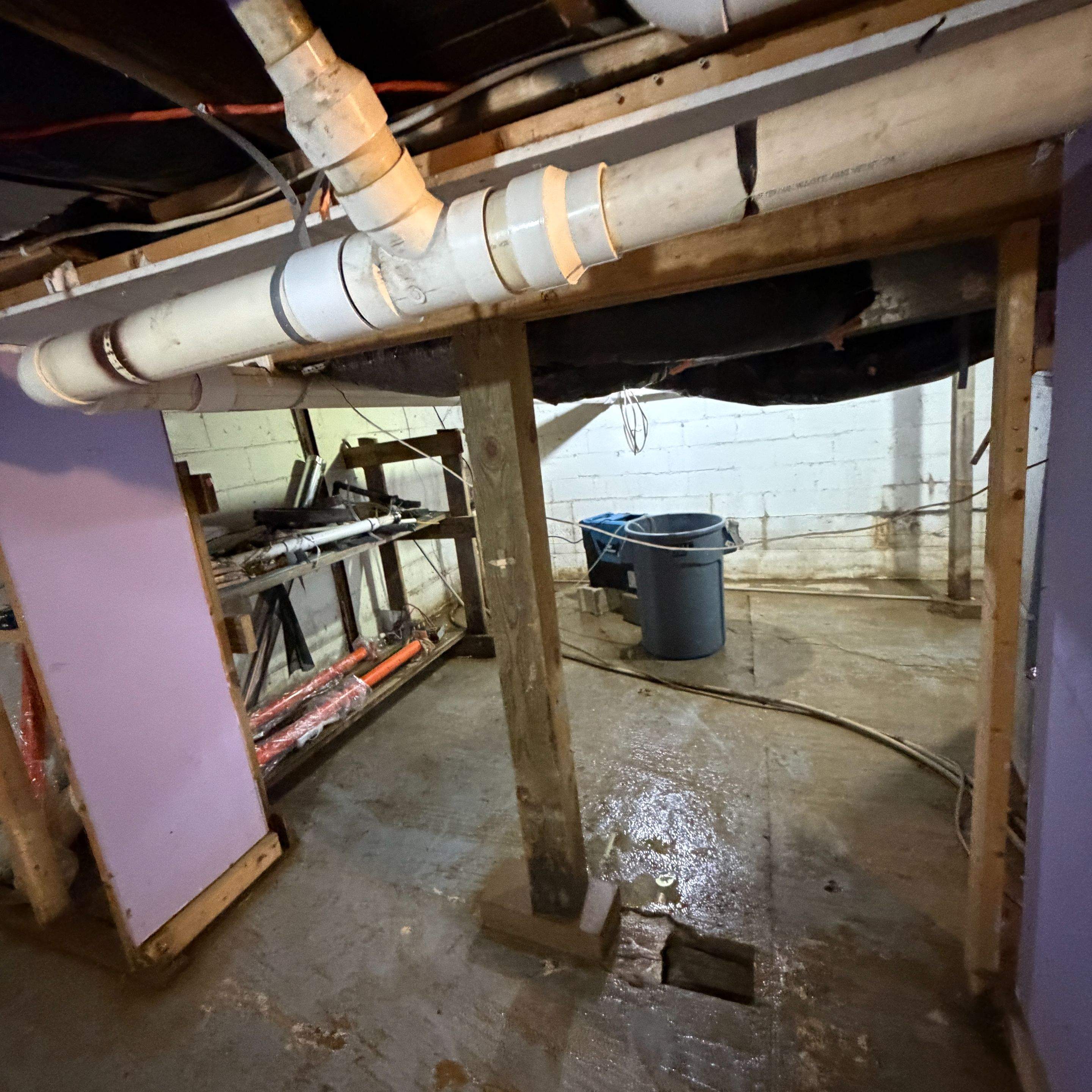
Before the Table: Why Every Flooded Basement Is Different
Two basements on the same Middletown street can flood the same night and need completely different cleanup approaches. The variables that matter most are the water source, how long the water sat, what materials it touched, and the square footage affected. A sump pump failure pushing clean groundwater across a finished basement is a Category 1 loss that can often be dried in place. A sewer backup through a floor drain is a Category 3 biohazard event that requires demolition, antimicrobial treatment, and disposal of porous materials. The cost difference between those two scenarios can be five times or more, even when the visible water looks identical.
Time is the other multiplier nobody wants to talk about. Water that sat for 6 hours behaves very differently than water that sat for 48. After roughly 24 to 48 hours, microbial growth begins, drywall loses structural integrity, and what started as a Category 1 loss legally and practically becomes a Category 2. Insurance adjusters know this, which is why documentation of when you discovered the loss and when mitigation began matters as much as the photos themselves. For a deeper look at the timeline pressure, our breakdown of 24 hour water damage restoration response walks through what should happen in the first day.
Construction type also changes the math. A poured concrete foundation with a finished frame wall holds water very differently than a block wall with a vapor barrier and batt insulation. Block walls trap moisture in the cores and wick it upward for weeks if the cavities are not addressed. Finished basements with engineered flooring, built-in cabinetry, or media rooms add layers of trapped moisture that simple surface drying will never reach. When Middletown Water Restoration arrives on a Middletown loss, the first 30 minutes are about understanding the assembly, not just the puddle.
The Comparison: Five Flooded Basement Scenarios in Middletown
The table below reflects what we actually see across central Indiana basements, with real ranges rather than marketing numbers. Costs assume a 1,000 to 1,500 square foot basement and standard ceiling heights. Your specific situation may fall outside these ranges, and we will tell you why during the inspection.
| Scenario | IICRC Category | Typical Drying Time | Equipment Needed | Demolition Required | Typical Cost Range | Insurance Outcome |
|---|---|---|---|---|---|---|
| Sump pump failure, clean groundwater, under 12 hours | Category 1 | 3 to 5 days | 4 to 6 air movers, 1 to 2 dehumidifiers | Minimal, often none if caught early | $2,500 to $5,500 | Usually covered if sump pump rider exists |
| Burst supply line, finished basement, 24 to 48 hours | Category 2 | 5 to 7 days | 8 to 12 air movers, 2 to 3 dehumidifiers, HEPA filtration | Baseboards, lower 2 feet of drywall, carpet pad | $5,500 to $12,000 | Typically covered under sudden discharge |
| Storm surge or surface flooding through window wells | Category 2 to 3 | 7 to 10 days | Full equipment package, antimicrobial treatment | Carpet, pad, drywall, possibly subfloor | $8,000 to $18,000 | Requires flood policy, not standard homeowners |
| Sewer line backup through floor drain | Category 3 | 7 to 14 days after demo | Containment, HEPA air scrubbers, full PPE protocols | All porous materials in contact zone | $10,000 to $25,000+ | Often covered with sewer backup endorsement |
| Long-term seepage discovered during renovation | Category 2 with mold | 10 to 14 days plus remediation | Containment, negative air, mold protocols | Affected drywall, framing if compromised | $6,000 to $20,000 | Rarely covered, considered maintenance |
After the Table: What These Numbers Actually Mean for You
The first thing most Middletown homeowners notice when they read this kind of breakdown is the cost spread. A flooded basement is not one price, and any contractor who quotes you over the phone without seeing the loss is either guessing or building in margin for the worst case. The honest answer is that the inspection determines the scope, and the scope determines the cost. We use moisture meters at multiple depths, thermal cameras to find hidden saturation, and we map the affected area before we write a single number on an estimate.
The second pattern worth understanding is how category drives demolition. In a Category 1 loss, we can often dry your drywall in place by drilling small holes behind the baseboard and forcing dry air into the wall cavity. In a Category 3 loss, that same drywall has to come out to roughly 24 inches above the waterline, no exceptions, because the IICRC S500 standard treats sewage-contaminated porous materials as non-salvageable. This is not a contractor preference, it is the published industry standard your insurance carrier uses to evaluate the claim. If you want the full step-by-step playbook, our guide on basement flooding and professional cleanup covers what to do in the first hours.
The third implication is about insurance. Notice how three of the five scenarios depend on specific endorsements, not your base homeowners policy. Sump pump failure, sewer backup, and flood are typically excluded by default in Middletown and most of central Indiana. If you have never reviewed your declarations page, do it before you need it. When the claim is denied, the cost shifts to you, and the scope of work does not change. For homeowners weighing how to pick a restoration partner, our piece on choosing a water damage company near you explains what credentials and documentation matter most.
The fourth takeaway is about drying verification, which is where many cleanups quietly fail. Equipment running for five days does not prove the structure is dry. Daily moisture readings logged against a documented dry standard prove it, and that paperwork is what protects you from secondary damage claims six months later when a baseboard starts buckling or a musty smell returns. Middletown Water Restoration leaves a written drying log on every Middletown job, with readings from unaffected reference materials compared to the affected assemblies. If the numbers do not converge, the equipment stays. That discipline is the difference between a basement that is dried and a basement that just looks dry on the surface while moisture continues to migrate through framing, sill plates, and insulation behind the walls you cannot see.